Pagan wedding traditions are ceremony rituals drawn from Celtic, Norse, Wiccan, and other pre-Christian spiritual paths, built around handfasting, elemental invocation, and offerings to gods or ancestors.
What separates a meaningful ceremony from a staged one is whether every element reflects beliefs the couple actually holds; borrowed aesthetics cancel each other out.
A cord braided in specific colors, a Quaich with paired handles forcing open palms, or a bay leaf burned with a written fear and not kept after, each carries weight because the objects were chosen for stories the couple can name.
Handfasting
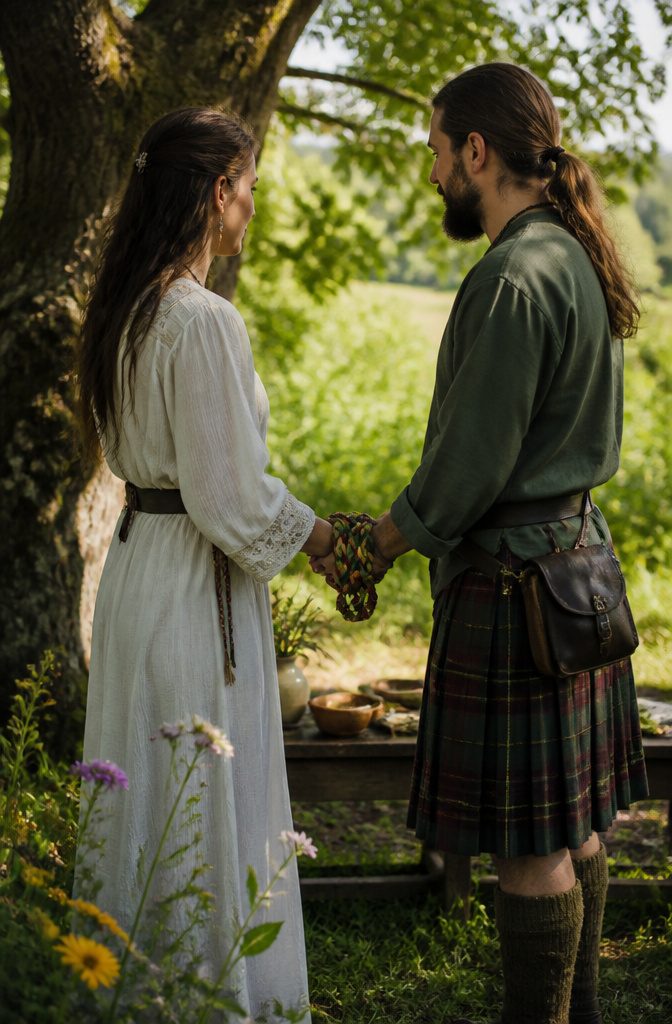
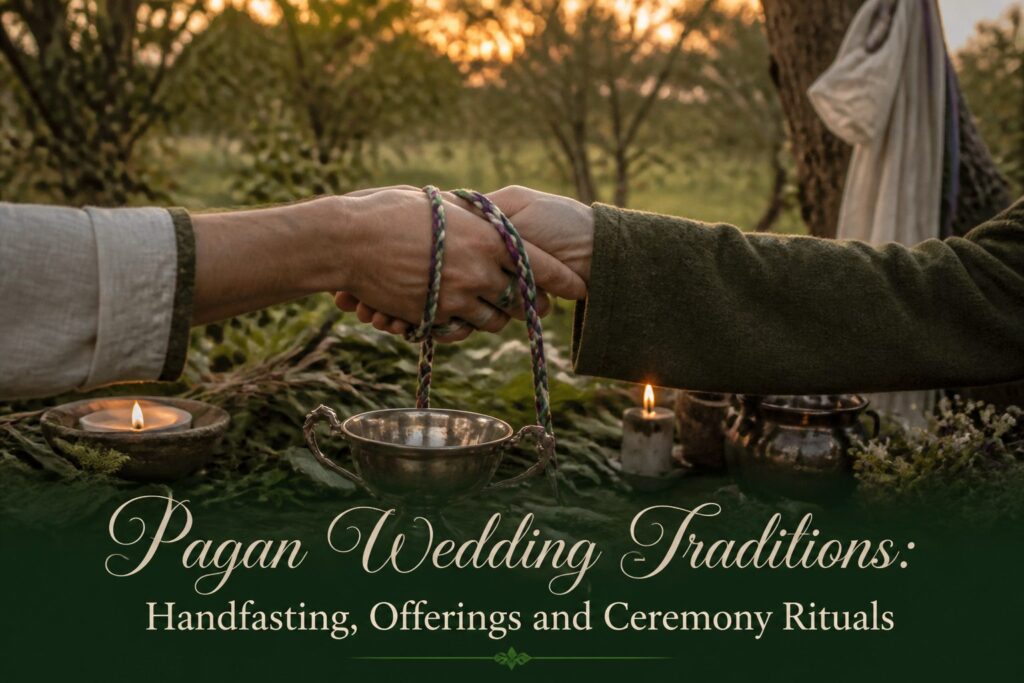
The handfasting is the central ritual most people picture when they think of pagan wedding traditions, and it carries more nuance than the binding alone.
A cord or ribbon is tied around the couple’s joined hands, wrists, or forearms, usually while vows are spoken and blessings given.
What struck me when I first looked into it is that this was originally a medieval trial marriage in Scotland and Ireland, not a lifetime commitment; the couple would live together for a year and a day, then decide whether to part or make it permanent.
That flexibility still shows up today. Some modern pagans use handfasting as betrothal or as the year-and-a-day custom itself, while others treat it as the full marriage rite.
The colors you choose for the cord carry weight. Blue ribbons stand for fidelity, unity, and harmony, though couples often braid multiple colors to layer meanings.
The ritual itself is the main Celtic marriage tradition, and it has crossed over into mainstream weddings as a unity ceremony, which says something about its staying power.
A priest, priestess, or honored guest typically does the tying, sometimes within a sacred circle that invokes the four elements or specific spirits.
The physical binding matters, but the spoken vows and blessings spoken over it are what turn a gesture into a commitment, temporary or not.

Complete Package: this elegant handfasting cord set for wedding includes not only the beautifully crafted cord but also comes with a heart shaped pendant; Imagine integrating this rustic setting of the lasso for your wedding ceremony encapsulated with the blend of tradition and exquisite taste


Complete Package: this elegant handfasting cord set for wedding includes not only the beautifully crafted cord but also comes with a heart shaped pendant; Imagine integrating this rustic setting of the lasso for your wedding ceremony encapsulated with the blend of tradition and exquisite taste
Jumping the Broom
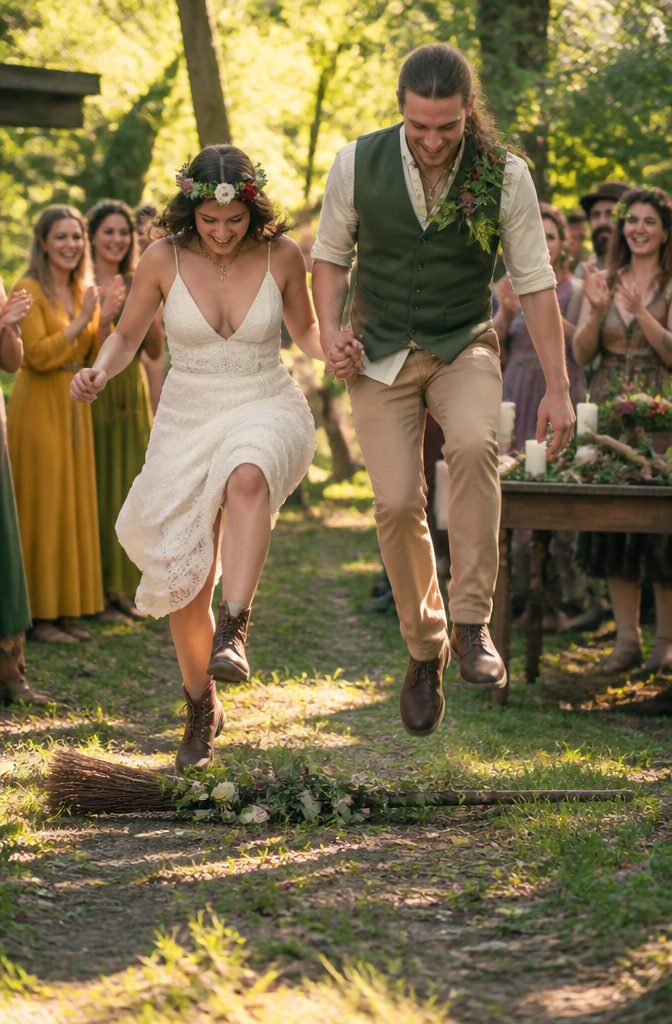
The broom sits on the ground at the end of the ceremony, laid across the couple’s path as they turn back toward their guests.
This is jumping the besom, and in pagan practice it marks the threshold between the ritual space and the life they’re stepping into together.
The shape itself carries meaning: the handle and the brush form a union, and the old folk reading sees fertility in that form.
Sweeping comes into it too.
A broom cleans, and the leap is meant to leave the old dirt behind, the past swept clear before the shared work begins. Some couples keep the besom by their own door afterward, a reminder that the threshold was real.
Placement matters for the flow.
After the vows and any ring exchange, after the handfasting cords come off if you’ve used them, the officiant sets the broom down. The couple jumps together, usually on a counted beat so the guests can join in.
In the US, some pagan ceremonies have shifted to sweeping the altar with the besom instead of jumping, a quieter gesture that avoids overlap with African American wedding tradition, where jumping the broom holds its own deep history.
The jump itself is short, but the symbolism runs long: a leap of faith, a new start, the luck of landing on your feet together.

Approximate Measurement: 8.5" Dia x 4.75"H inches

Solid Copper Bowl: Made from durable 100% copper for long-lasting use.

LIFE TREE DESIGN: The offering bowl features the life tree symbol, a classic motif in many spiritual traditions, which adds meaningful detail to your altar space, making it a suitable fit for Wiccan, pagan, or witchcraft-themed decor
Circle Ceremony
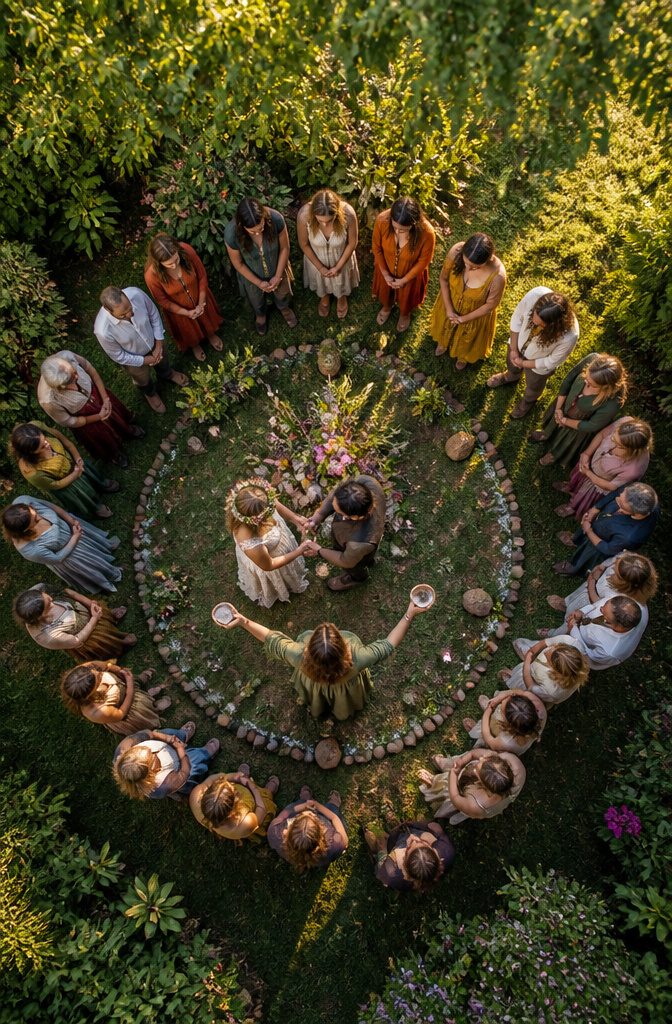
Guests gather in a circle around the couple and officiant, standing or sitting, instead of the usual arrangement where the couple faces rows of seated guests.
The circle itself can be marked with stones, flowers, salt, or other natural items to create a boundary between the everyday world and the ceremony space.
This shape draws on the Caim, a protective prayer where a circle is drawn around the couple, often traced in the earth, to bless and safeguard the marriage.
The officiant may call to gods, goddesses, spirits, or ancestors to join the event, lighting incense or sage to create a spiritual circle that surrounds the physical one.
The spatial arrangement matters because it makes every guest a witness rather than an audience. There is no front or back, no separation between couple and community.
Friends and family may participate with poetry, song, or storytelling, and the gathering can stretch for hours. The couple stands at the center, but they stand within the group, not apart from it.

Jumping the Broom is a symbol of sweeping away the old and welcoming the new, or a symbol of new beginnings. Your ceremonial wedding broom should be as beautiful as the tradition it represents.

Complete Package for DIY Enthusiasts: our kit contains 1 wedding brooms for jumping, 2 rolls of ribbons, 100 pearls in a pack, 2 eucalyptus leaves, 14 artificial roses (small and large), and 1 delphinium, these elements can be arranged as desired, letting you add and DIY a personal touch to the broom, please note that you will need to bring your own hot glue gun and scissors for assembly

Jumping the Broom is a symbol of sweeping away the old and welcoming the new, or a symbol of new beginnings. Your ceremonial wedding broom should be as beautiful as the tradition it represents.
Offerings to an Altar
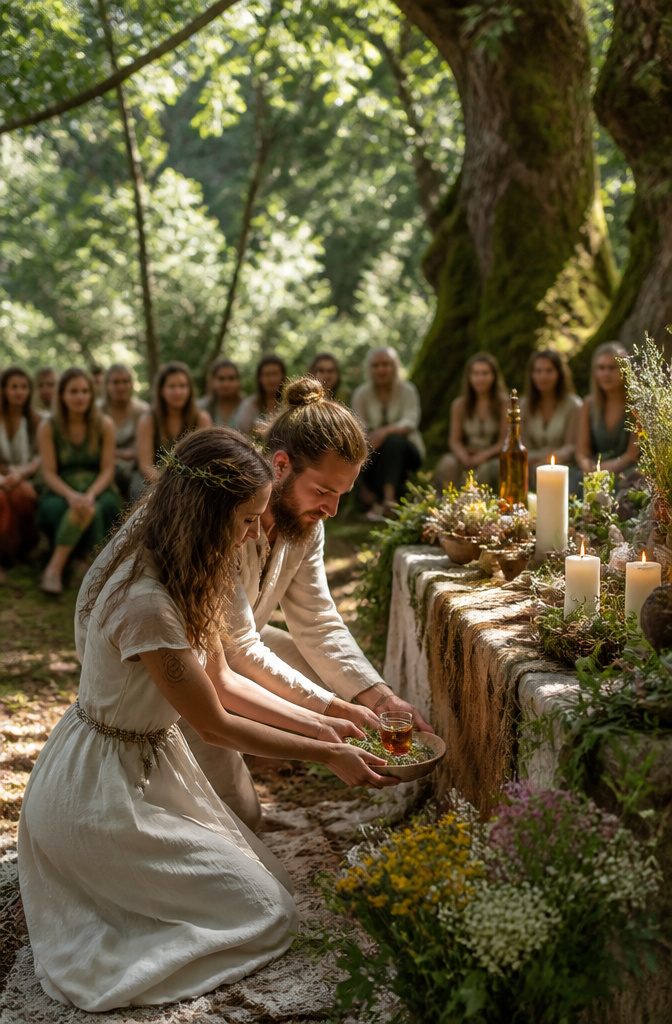
The altar itself is already a statement: cloth, candles, the tools a couple has gathered over years of practice. What turns it from decoration into ritual is the offering placed there with intention.
A dish of honey wine set out for a goddess of fertility, herbs dried from last summer’s garden, a crystal carried since adolescence. These objects carry the weight of private meaning, and that weight matters more than any prescribed list.
Candles and incense line most pagan altars, and the light and smoke do practical work too, marking the space as set apart.
Outdoors, skip the open flame if the ground is dry or the season brings fire risk; an unlit candle still counts as an offering, and a grassy field does not need to become part of the ceremony.
Some couples burn their offerings, sending wine or written words into a bonfire or hearth fire before the meal that closes the celebration. Others leave the objects in place, letting the gathered witnesses see what they have chosen to value.
The choice between burning and keeping is a judgment call, not a rule; what ranks higher is that the items were selected for reasons the couple can name, not bought in a kit because they seemed appropriately mystical.
Wine, flowers, herbs, a blade you have worked with before: the specifics are less important than the story each object carries into the space. An altar built from those stories becomes a place where the ceremony can actually begin.
Exchanging Rings
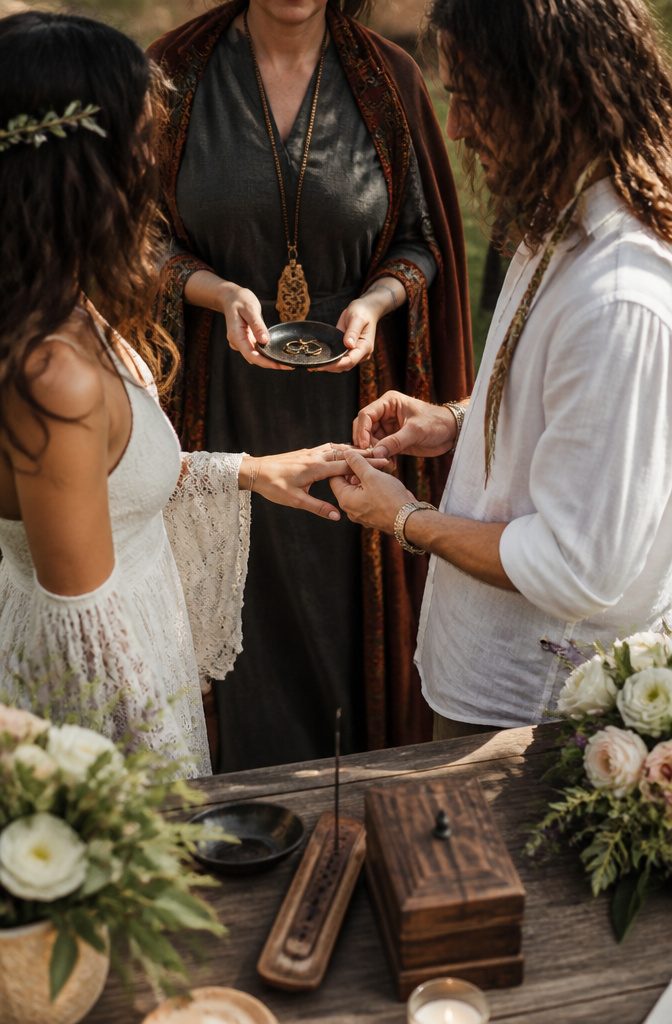
The ring exchange is the moment most guests recognize, even when the rest of the ceremony pulls from older pagan wedding traditions.
A ring is a circle with no break, and in Wiccan, Pagan, and Celtic practice that unbrokenness carries weight: it stands for completion, the idea that two people now form something whole.
I have seen this play out at ceremonies where handfasting and altar offerings left some relatives quiet and uncertain.
The rings brought them back in. The couple still spoke vows rooted in the same tradition, but the familiar gesture of sliding metal onto a finger gave the older generation an anchor.
That familiarity is not a compromise. Celtic pagan weddings have included ring exchanges alongside the binding of hands for generations; the two rituals share space rather than one displacing the other.
The practical question is order. Sealing the handfasting first, then the rings, lets the couple move from the less familiar ritual to the one their guests understand without explanation.
Sword or Dagger Exchange
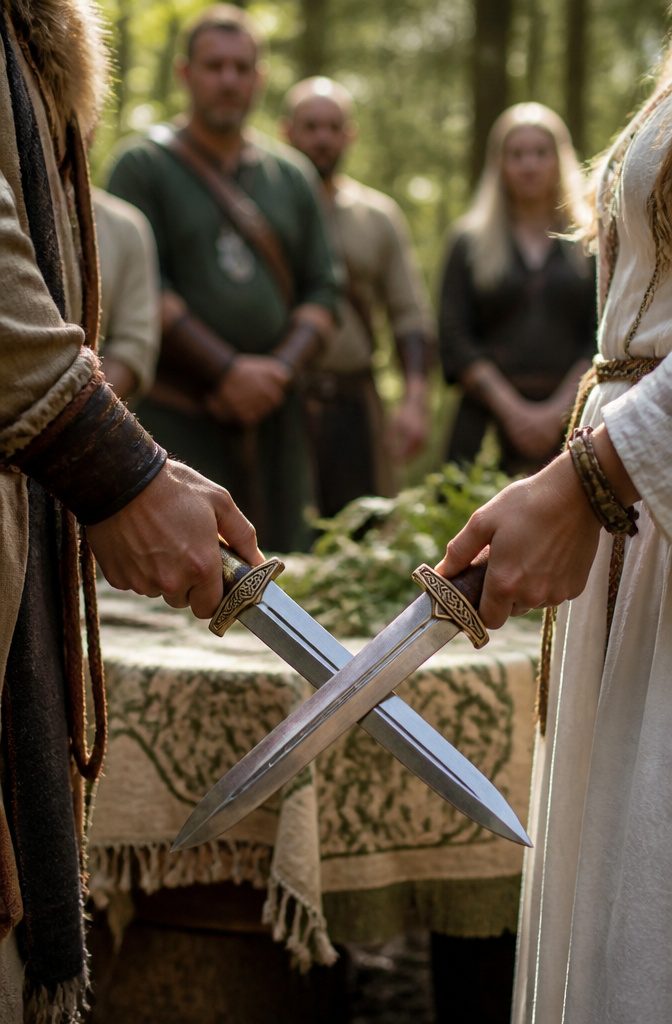
Exchanging swords or daggers comes from Pagan and Viking traditions and works as either a replacement for rings or an addition to them.
The gesture carries the same weight as slipping a band onto a finger, but the symbolism shifts toward protection and mutual defense.
A couple might choose this path if jewelry feels too conventional, or if one or both partners already wear rings they do not want to replace.
The daggers or swords are presented to each other during the ceremony itself, not hidden away as props.
Some couples pair the exchange with their rings, passing steel and gold in the same sequence, while others skip the metal bands entirely.
The choice tends to suit pairs who want the ritual to reflect a more martial or grounded partnership, or who simply prefer the visual of blades to the flash of gemstones.
Not every officiant will know how to frame this moment, so asking early matters.
The same goes for checking whether the venue permits even ceremonial blades on site. Budget-wise, a decent dagger runs less than a mid-range wedding band, though antique or custom pieces can flip that equation fast.
Blessing the Space
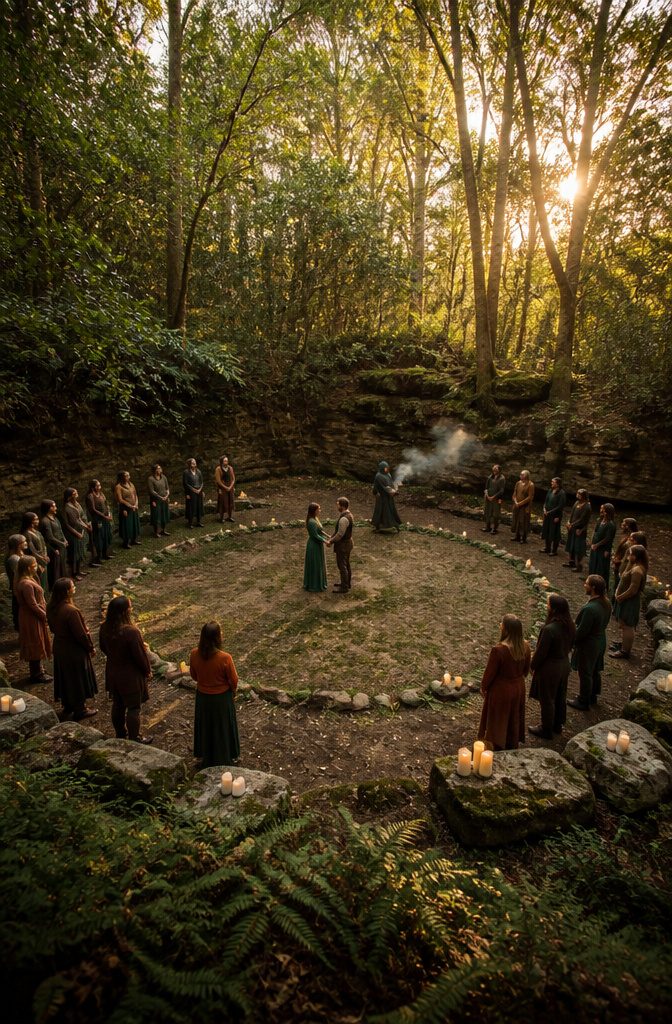
The officiant begins by walking the perimeter with lit incense or sage, letting the smoke drift across the threshold and into each corner. This isn’t about fragrance.
Different herbs carry different intentions: cleansing, love, protection, or passion. The smoke marks a boundary between ordinary space and what follows.
While the smoke rises, the officiant calls in the four elements. North for Earth, grounding and stability.
East for Air, clarity and new beginnings. South for Fire, passion and transformation.
West for Water, intuition and emotion. Each direction receives its own spoken invitation, asking that its particular gift attend the couple.
A word on sage. The white sage used in traditional smudging carries deep significance for many Indigenous tribes.
If that lineage isn’t yours, incense avoids the issue entirely. Frankincense and myrrh have served this purpose across enough centuries and cultures to raise no eyebrows.
The whole blessing takes perhaps five minutes. Guests feel it shift the room, even those who came skeptical.
Bay Leaf Burning
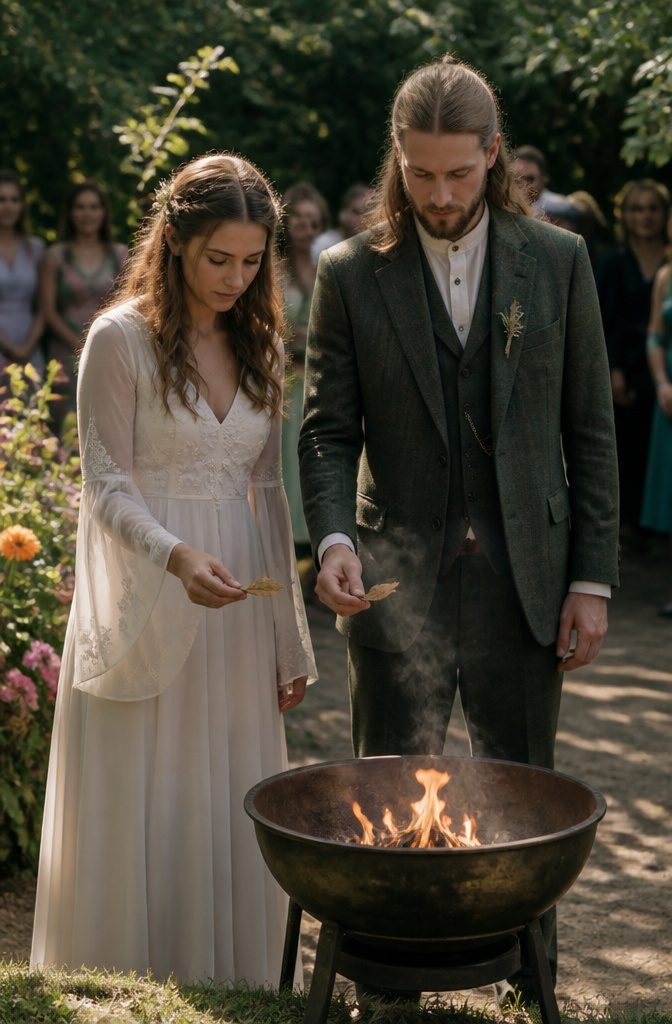
Bay leaf burning usually happens before the couple speaks their vows, when the space is quiet and the guests are watching.
Each partner holds a dried bay laurel leaf, often one they have written on earlier with something they want to release: a fear, a debt to the past, an old pattern that has followed them into the relationship.
The officiant lights a small fire in a heatproof bowl, and the couple feeds their leaves into the flame one at a time.
Anna, who leads ceremonies through Ecstatic Ceremonies, described the moment as practical emotional work rather than theater.
The smoke rises, the couple stands together in the silence after the last leaf catches, and the officiant marks the shift: what burned stays burned, and what comes next starts clean.
The leaves are not saved; the ash is not kept. The gesture only works if you actually let it go.
Some couples choose to write a single shared fear on one leaf and burn it together.
Others write separately and do not share what they wrote. Either way, the ritual takes under two minutes and costs the price of a grocery-store herb packet.

🌿 Elegant Design: Our wedding broom is a masterpiece of craftsmanship, featuring a meticulously crafted straw broom design that is perfect for traditional jumping ceremonies. Its Asian broom style infuses a touch of cultural elegance and sophistication into any event, making the broom not only a functional tool but also a decorative piece that enhances the aesthetic appeal of your special occasion.


The Quaich Ceremony
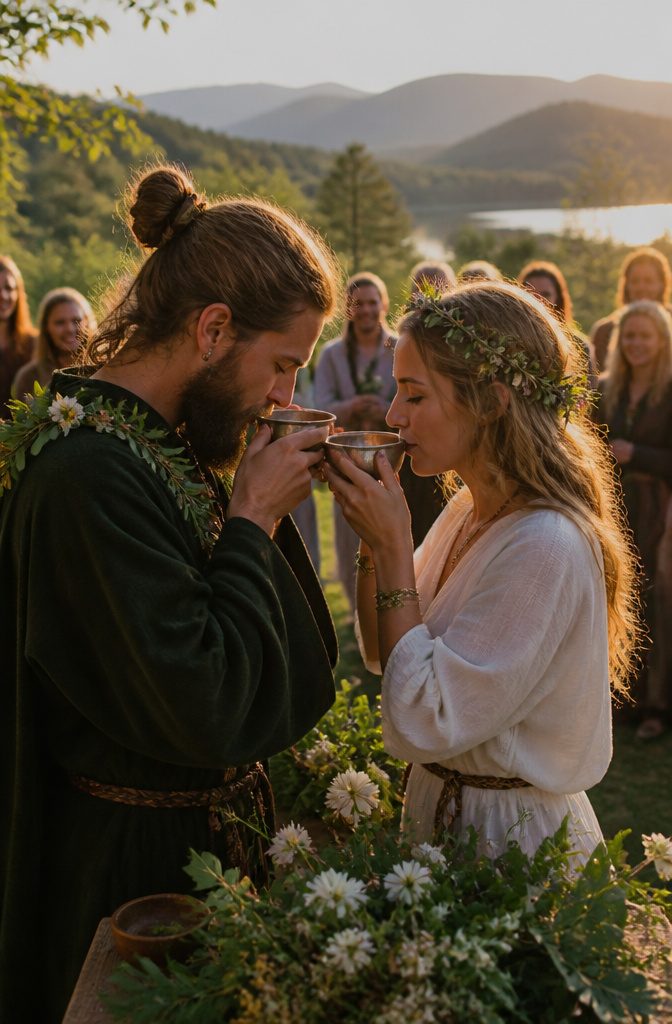
The Quaich ceremony brings a Scottish thread into pagan wedding traditions, though records of the cup itself only reach back to the 16th century.
A two-handled loving cup gets filled with wine, mead, or whiskey, and both partners drink from it in turn.
The shared vessel matters more than the liquid inside: taking the cup with both hands means you cannot hide a weapon, so the gesture carries trust built into its mechanics.
One partner drinks, then passes it across; the second drinks from the same rim. Some couples add a third sip poured onto the earth as offering.
The Quaich works best when you source an actual cup rather than substituting a standard goblet, because the paired handles force the physical openness that makes the symbol land.
For a budget under $10K, this is one ritual where the object earns its keep: a simple pewter Quaich runs about $40–$80, and you keep it afterward as the first shared dish in your married kitchen.
The Scramble
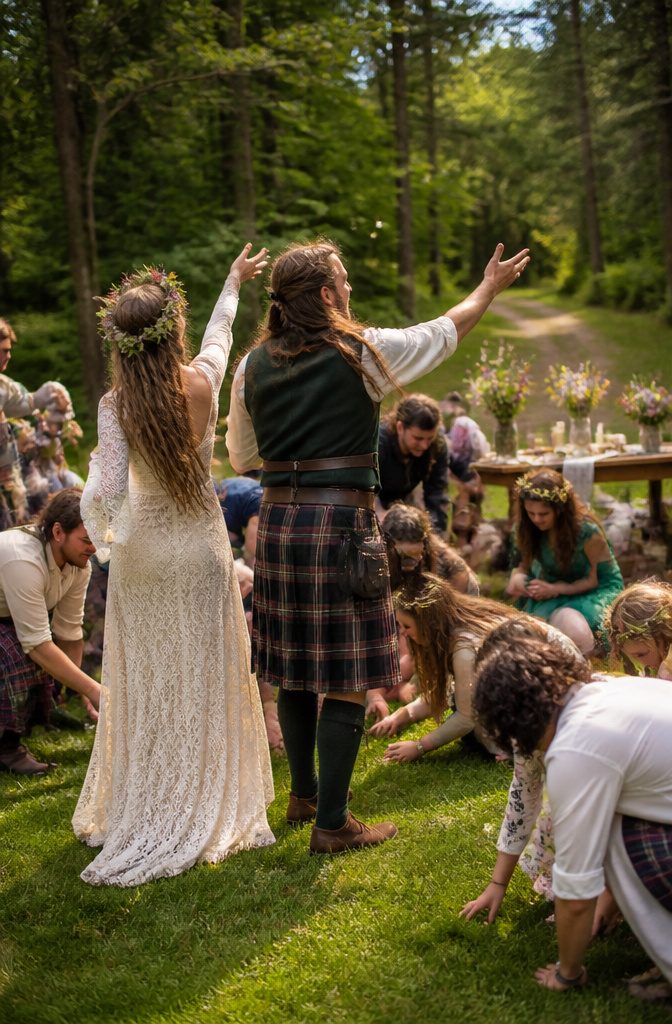
The scramble is a Scottish tradition that fits a pagan wedding well, especially if you are pulling from Celtic roots.
The couple throws coins to the guests, and the scramble for them is meant to bring prosperity and good fortune to everyone who catches one.
It is a quick, joyful moment, not a formal part of the ceremony, so most couples slot it in after the vows or during the recessional when the energy is already high.
I have seen this done two ways: the groom throws for the bride’s family, and the bride throws for his, or the couple throws together into one crowd.
Either works. The coins do not need to be old or valuable; copper pennies or washed thrift-store coins are fine.
Guests know the drill once they hear the clink, though a brief cue from the officiant helps if most people in the room have never been to a Scottish wedding.
The practical limit is space. Outdoors on grass, the scramble works beautifully.
Indoors with a polished floor, someone will slide into a table. Plan for that, or hand coins rather than throw them.


Rice Throwing
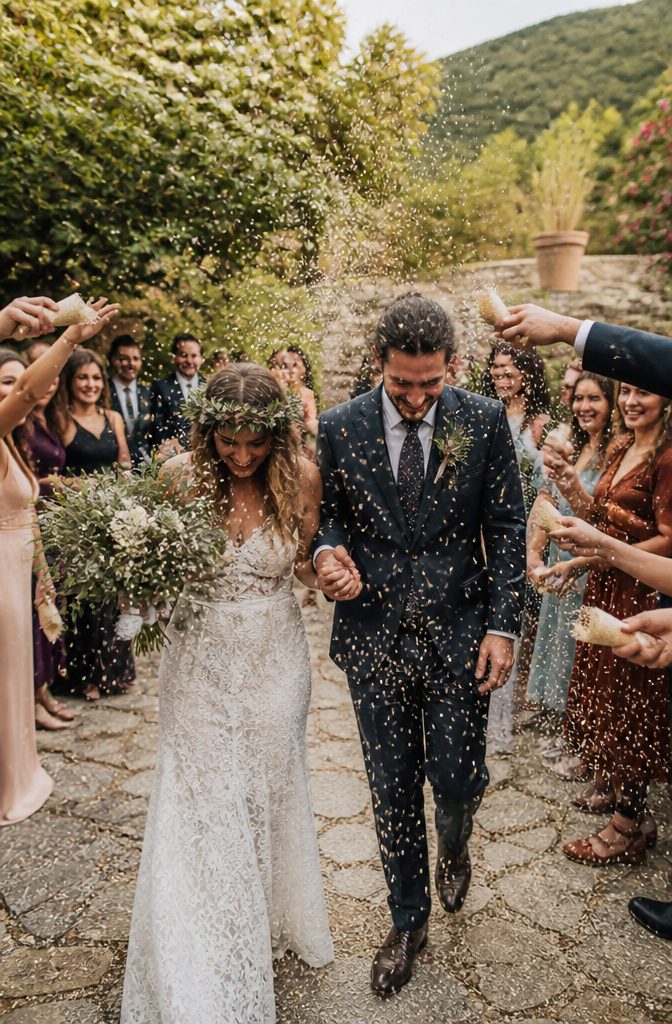
Rice throwing at a wedding carries the same meaning it did for centuries: the wish that a new household never go hungry.
Guests toss grains as the couple leaves the ceremony, each kernel standing for seed, growth, and the prosperity of a full pantry.
The gesture fits naturally after a pagan handfasting or circle closing, when the couple steps back into ordinary time and the community’s blessing goes with them.
Outdoor settings demand one practical check. Dried rice left on grass or soil can attract wildlife, and some venues now bar it outright.
Birdseed works as a direct substitute, though it carries its own complications; individual paper cones of lavender or rosemary needles scatter cleanly and leave a scent behind.
If rice matters symbolically to you, a small bowl set on the altar for guests to handle during the ceremony satisfies the tradition without the cleanup.
Seasonal Celebrations
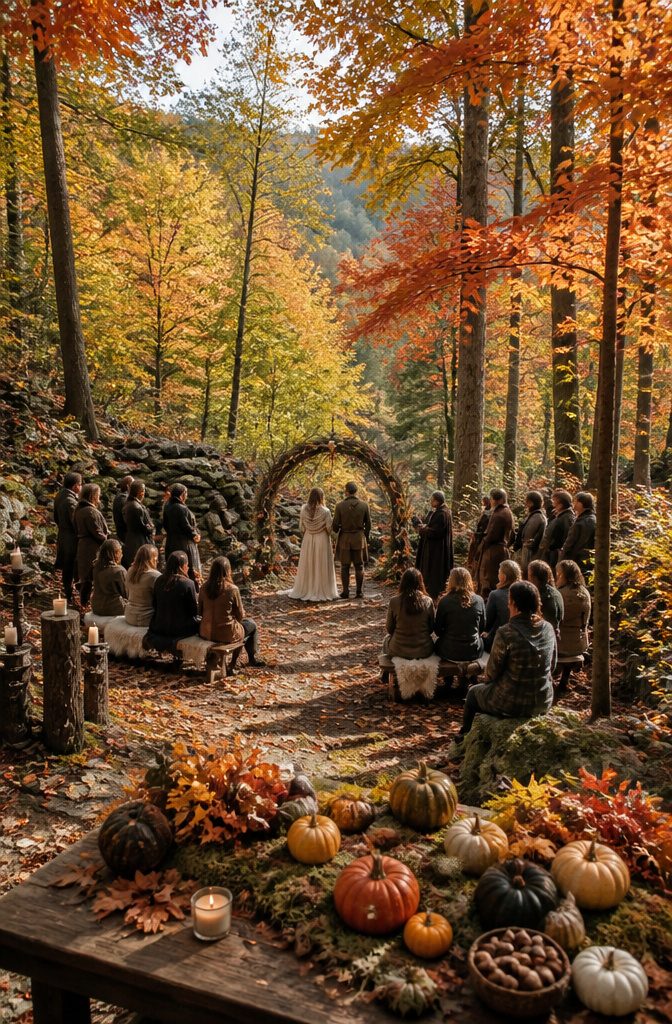
The Pagan Wheel of the Year marks eight major festivals, and couples drawn to pagan wedding traditions often choose dates that align with these turning points rather than defaulting to a convenient Saturday.
Beltane in early May carries the energy of union and fertility; Samhain at the end of October, when the veil between living and dead thins, suits pairs who want to honor ancestors as they begin their own lineage.
The summer solstice, the longest day, appeals to those with a practical or creative tie to light and angle, like the architecture students who picked it because their training had taught them to design for the sun’s extremes.
Some dates shift slightly year to year, so checking an astronomical calendar matters if you’re set on an exact alignment.
The spiritual weight of the day becomes the reason to accept a Friday or mid-week slot, or to brave colder weather for an October ceremony.
What you’re trading is convenience for meaning, which is the same budget-versus-dream calculation that runs through every wedding choice, just measured in date instead of dollars.
Nature and Outdoor Settings
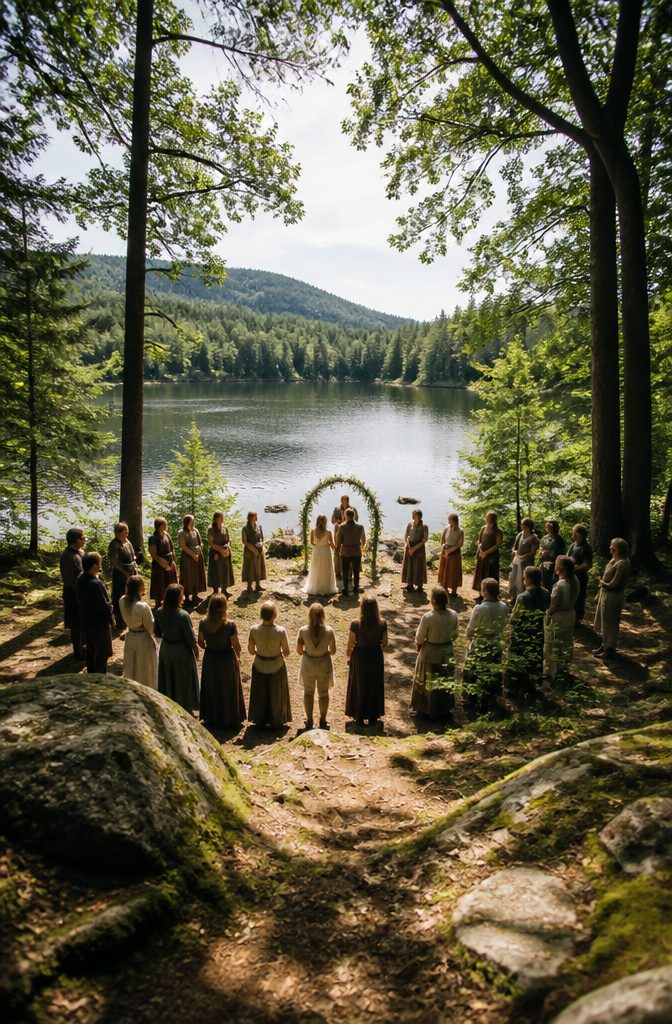
Most pagan wedding traditions simply do not work indoors.
The ceremony needs the ground underfoot, the sky overhead, and enough space to cast a circle with flowers, straw, or stone. Forests, gardens, and sites chosen for their spiritual significance are the usual settings, not the exception.
Scotland has become a popular destination for exactly this reason. The laws there allow legal weddings almost anywhere outdoors, and the abundance of lochs and wild landscapes fits the ceremony’s natural focus.
A circle marked with symbolic materials and the quarters called at the opening only feel right when the elements are actually present.
The practical side matters too. An outdoor location determines your timing, your backup plan for weather, and whether guests can participate in poetry, song, or storytelling without the acoustics of a room working against you.
Druid weddings in particular can last well into the night, so the site needs to permit that without hard cutoffs.
Rain on the day carries its own meaning in these traditions: it is considered good luck, which is worth remembering when you are choosing between a venue with a tent included and one without.
Invoking the Elements
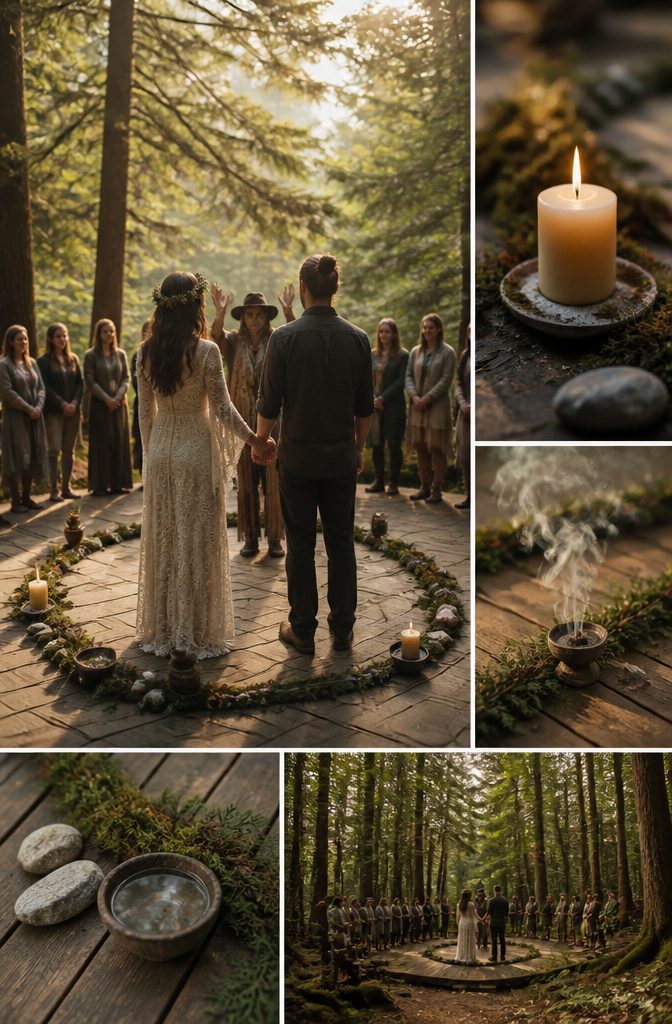
The four elements form the backbone of most pagan wedding traditions, turning an ordinary outdoor spot or living room into sacred ground.
The officiant, or sometimes the couple themselves, faces each quarter in turn: Earth at North for grounding and stability, Air at East for clarity and new beginnings, Fire at South for passion and courage, and Water at West for intuition and emotional depth.
Each invocation can be spoken, sung, or marked with a physical token like a bowl of soil, incense, candle, or poured wine.
This structure rarely stands alone.
In the ceremonies I’ve studied, the elemental calling opens a wider ritual that later includes handfasting itself, ancestor recognition, or deity invocation. The circle gets cast, the elements get welcomed, and only then do the couple’s hands meet the cord.
Water at West sits last for a reason: the emotional weight of what follows lands harder once intuition and love have been formally seated in the space.
Some pairs keep it spare with a single word per direction; others write a paragraph.
The quarter system stays fixed either way, and that predictability is what lets couples color inside it without losing the thread of tradition their guests came to witness.
Personalizing Your Ceremony
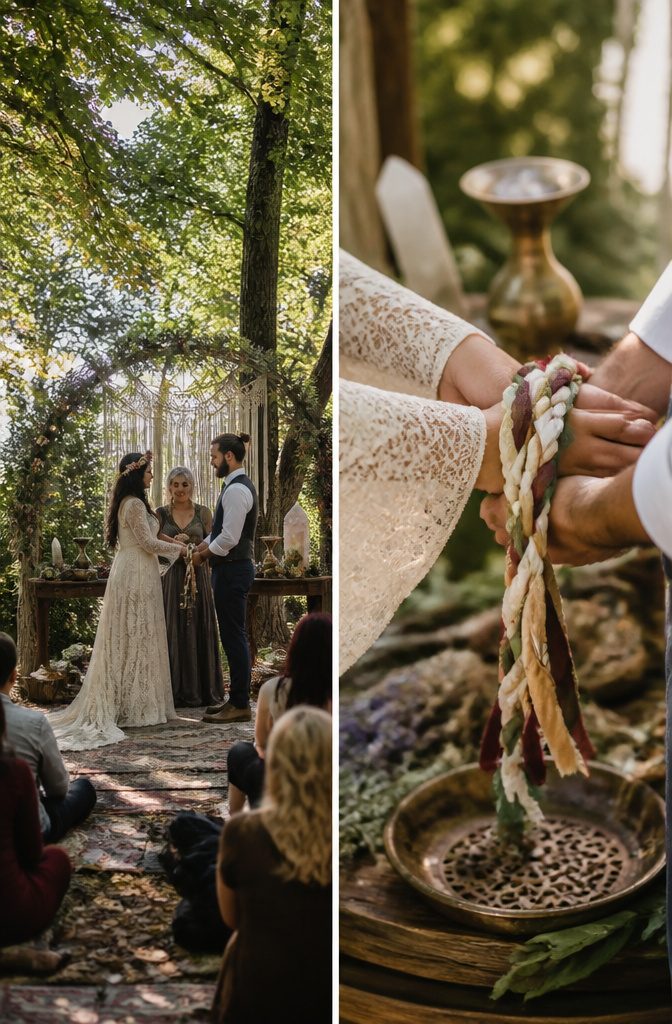
The ceremony is where pagan wedding traditions stop being historical curiosity and become yours.
A nature-based celebrant can shape every moment around your actual beliefs, your love story, even the landscape you’ve chosen, so the ritual carries weight instead of performance.
Some couples blend paths: a handfasting cord in colors that nod to one partner’s Irish roots, a ring exchange that borrows wording from a Wiccan script, a Celtic knot worked into the invitation wax seal or the choker the bride wears.
The knot itself, a pagan symbol of eternity and unbroken connection dating to around the 3rd century AD, threads through jewelry, décor, or the cord that binds your hands.
Others build something newer: a fire lit only from last year’s preserved embers, vows spoken facing the direction where you first met.
The best ceremonies layer.
Guests participate instead of observe. Ancestry gets honored without the costume-drama feel.
Every element should reflect values you actually hold, not aesthetics you saw trending. A celebrant experienced in pagan or nature-based work helps enormously here; they know which combinations deepen emotional resonance and which ones cancel each other out.
Skip the parts that feel borrowed. Keep the ones that feel inevitable.
Guest Participation
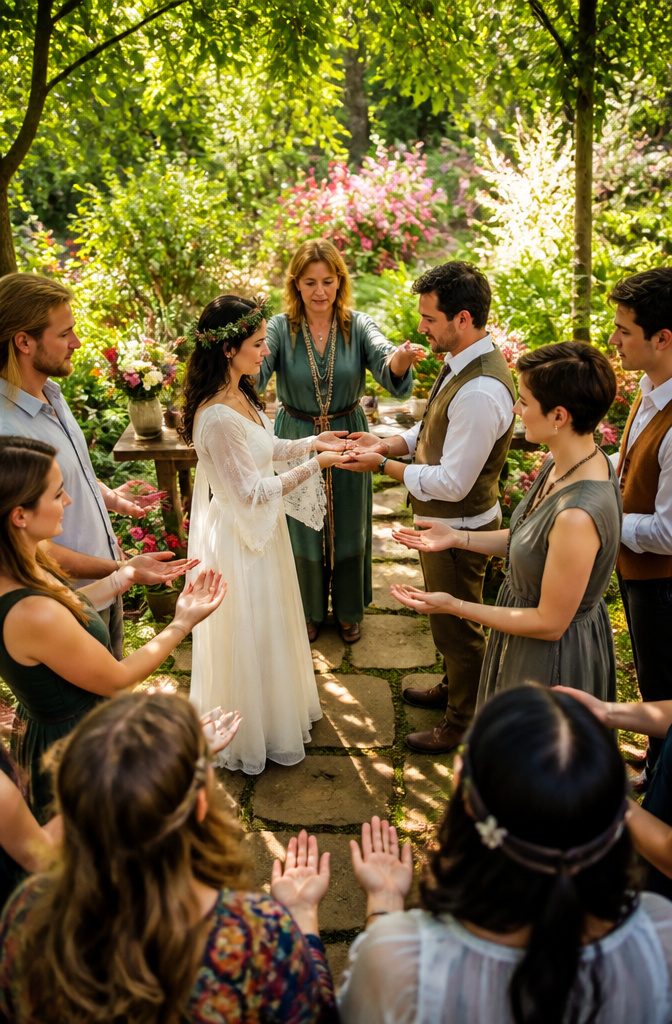
Guests in pagan weddings are not spectators arranged in rows. They stand or sit in a circle around the couple and officiant, forming the boundary of sacred space together.
Pass the rings through every pair of hands before the exchange, letting each guest warm them with a silent wish or spoken blessing.
At a Romuva ceremony, a woven band circles the gathering the same way, collecting intention before it binds the couple’s hands.
The circle itself does the work of inclusion, but too many moving parts turn a ritual into a rehearsal.
Limit active roles to three or four people at most. One guest calls a quarter.
Another reads a poem. The rest contribute by presence alone, their attention holding the space.
A Lithuanian wedding I read about kept everyone involved through song instead: call-and-response hymns to Gabija, Žemyna, Laima, and Perkunas, with guests singing along even when they did not know the language.
The final hymn belonged to the couple alone, sung while they fed each other honey from the same spoon and drank mead from a conjoined cup.
If you want spoken blessings, collect them during the reception rather than the ceremony. The circle stays intact, the pacing breathes, and no one waits through twenty well-wishes to eat.
Music and Cultural Threads
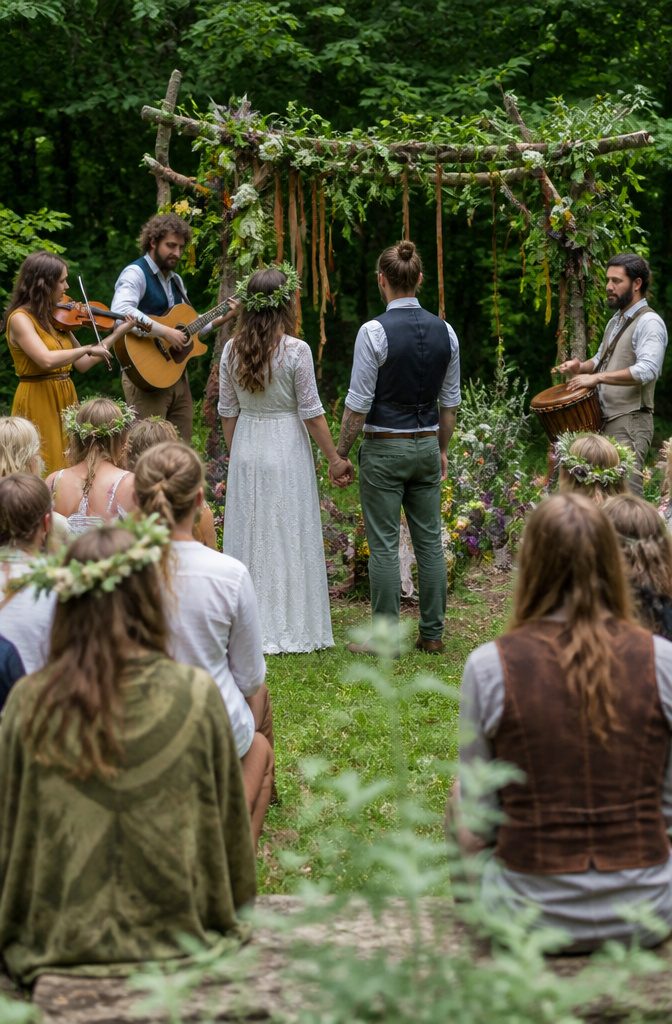
Music in a pagan ceremony does not fill silence; it shapes the room.
A single drum or a line of voices turns a backyard or a rented hall into something older, something the guests feel before they name it. The couple chooses the sound, and the sound chooses the mood.
Lithuanian practice carries this further than most. Romuva weddings, led by high priestesses who fought decades for state recognition, weave folk songs called sutartinės into the ritual itself.
These are not background tracks; they are call-and-response patterns guests learn on the spot, threading the assembly into one voice. Lithuania held out as Europe’s last pagan nation, so its song archives run deeper, with 19th-century collections still in use.
Norse pagans face the opposite problem: almost no wedding music survives from the pre-Christian era. What exists is inference, mostly from the Þrymskviða, where Thor’s sham wedding to a giant includes blessings with his hammer, Mjölnir.
Couples who want that lineage often build around percussion and spoken verse rather than reconstructed melodies, or they blend Heathen elements with familiar wedding forms so guests feel grounded, not lectured.
Heritage is a starting point, not a script. A Lithuanian-American couple might hire a Romuva-trained singer; a couple drawn to Norse roots might ask a friend to speak vows over a stone while a frame drum marks the pulse.
The question is whether the sound belongs to the people in the room, or only to the couple at the center.
Frequently Asked Questions
What is the Celtic ritual for marriage?
Handfasting is the central Celtic marriage ritual, where a cord or ribbon is tied around the couple’s joined hands, wrists, or forearms while they speak vows.
The practice originated as a medieval trial marriage in Scotland and Ireland, with couples living together for a year and a day before deciding to part or commit permanently.
Modern pagans may use it as betrothal, as the year-and-a-day custom itself, or as the full marriage rite.
What are some Pagan wedding traditions?
Pagan wedding traditions include handfasting with colored cords, jumping the broom or besom, circle ceremonies where guests surround the couple, offerings placed on altars, ring exchanges, sword or dagger exchanges, blessing the space with incense or sage, bay leaf burning to release fears, the Quaich ceremony with a two-handled cup, and the scramble where coins are thrown for prosperity.
Many couples also align their date with seasonal festivals like Beltane or the summer solstice.
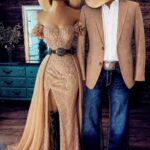
What to wear at a pagan wedding?
Guests should expect an outdoor ceremony in many cases.
Is handfasting against Christianity?
It does note that handfasting has crossed over into mainstream weddings as a unity ceremony, suggesting it functions as a cultural ritual separate from any single religious affiliation. Couples interested in combining traditions should consult their own clergy or officiant.
Are pagan marriages legal?
Legal status depends on whether the officiant meets local jurisdiction requirements and the couple obtains proper licenses; a handfasting itself is symbolic unless paired with the civil paperwork.
What are some common pagan wedding vows?
Pagan wedding vows focus on protecting each other and inviting blessings into the marriage rather than hierarchical or controlling language.
During handfasting, vows are spoken while the cord is tied, and couples may also speak promises during ring or blade exchanges.